
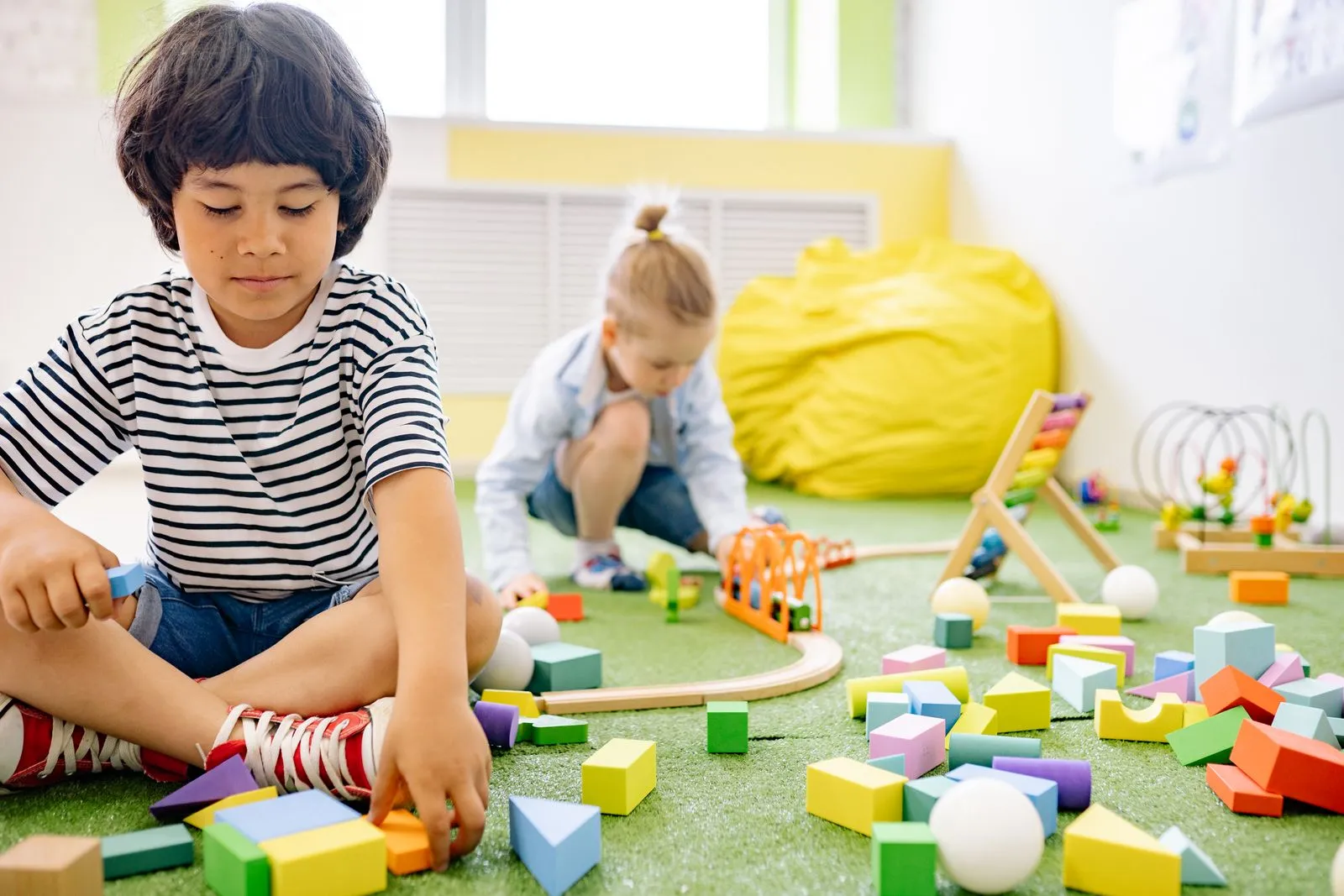
Children encounter language through the people and activities that fill their day. In a bilingual daycare, a pretend shop, a shared story, or a familiar mealtime routine can create meaningful opportunities to hear and use two languages. The goal is not to turn every moment into a lesson. Instead, caregivers offer warm conversation, repeat useful words in context, and make space for children to respond in the ways they are ready to.
Play Gives Words a Purpose
Play connects words with things children can see, touch, and do. While building with blocks, a caregiver might describe a tower as tall, ask for a red block, or model words for stacking and falling. In a bilingual setting, those ideas can be expressed in both languages across the day, helping children link meaning to context rather than memorize isolated vocabulary.
Pretend play invites children to use language to make plans and share ideas. A toy kitchen can prompt requests, turn-taking, and simple choices; a pretend store can bring in names for foods and everyday exchanges. Caregivers can follow the child’s interest, introduce a few relevant words, and allow time for the child to answer with a word, gesture, or action.
Conversation Builds Connection
Everyday back-and-forth conversation helps children learn that language is a way to connect. A caregiver can notice what a child is doing, describe it in simple phrases, and respond to the child’s sounds or words. Pausing after a question or comment gives the child room to take a turn without pressure.
Children may understand more than they can say, and they may mix words from both languages as they communicate. Caregivers can respond to the meaning, then naturally model a useful phrase in the language being used. This keeps conversation supportive and gives children examples to draw on, without treating mixed-language speech as a problem.
Routines Make Language Familiar
Repeated routines create predictable moments for hearing the same useful words. Greeting, washing hands, putting on a coat, and tidying up each have familiar actions that caregivers can describe consistently. When children know what happens next, they can connect words with the sequence and begin to anticipate or participate in it.
Songs, picture books, and simple phrases can make transitions feel warm and recognizable. Caregivers can use a short greeting in one language and a farewell in another, or revisit a favorite story in either language. Families can share words and expressions used at home so daycare routines feel respectful of each child’s language experiences.
Support Both Languages Together
Children benefit when both languages have genuine places in the day, rather than appearing only during formal instruction. Caregivers can plan activities that invite children to listen and respond in each language, while adapting to their ages, interests, and comfort. A child might answer in one language while understanding a question in another; that exchange still supports communication.
Families can reinforce this approach by talking, reading, and singing in the languages they know best. There is no need to translate every sentence or quiz children on vocabulary. Sharing favorite books, songs, and expressions with caregivers helps create continuity between home and daycare and gives children more meaningful ways to encounter both languages.
Bilingual daycare supports early language learning through meaningful moments: play that invites expression, conversations with room for a response, and routines children can recognize. Families can ask caregivers how both languages appear throughout the day and share what their child enjoys at home. Wellington Bilingual Care welcomes families to learn more about its approach.